Feeds:
Posts
Comments

One of the dominant threads I pay attention to is the role of the unseen in the realm of the physical.  Somehow, when I am with other Hawaiians that kicks into turbo.  After Meleanna Meyer’s invitation to an art installation event last Thursday arrived, part of the KUʻU ʻĀINA ALOHA project at Mark’s Garage, I lost no time inviting her to speak about it the following Friday on Think Tech Hawaii.

http://

It was the perfect follow-up to the previous week’s talk with Jon Osorio about the Department of the Interior’s announcement.

The talk with Osorio was distressing in many ways.   The current flurry of activity in labyrinthine processes facing Native Hawaiians seeking restitution, in some as-yet-amorphous dominion, for the loss of Kingdom, kin and culture seem devilishly calculated to distraction from the primary work of personal healing.  How can we work effectively together on political solutions when so many of us are in abject pain, poverty and disease?

The most potent message from Meyer was that holistic healing needs to happen on a personal level, as a first priority. Meyer’s multidimensional project, with David H. Kalama Jr. as Co-creator,  has been a vehicle for her transition.  Suddenly it all made much more sense.

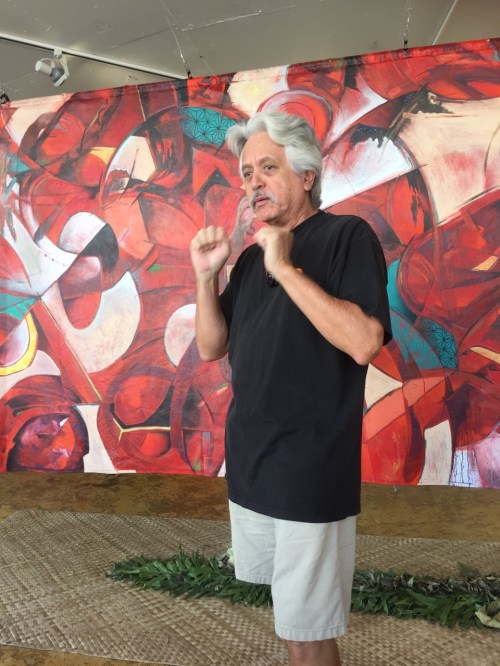
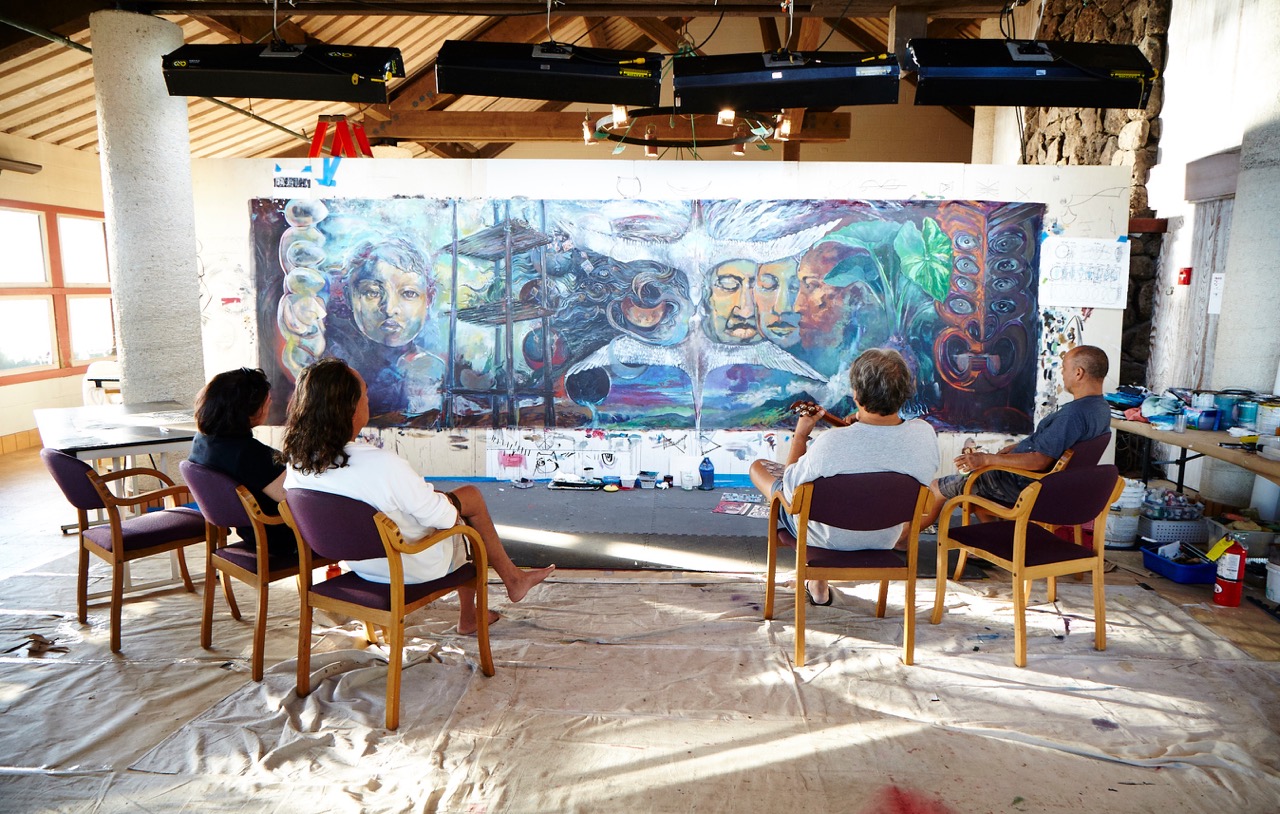
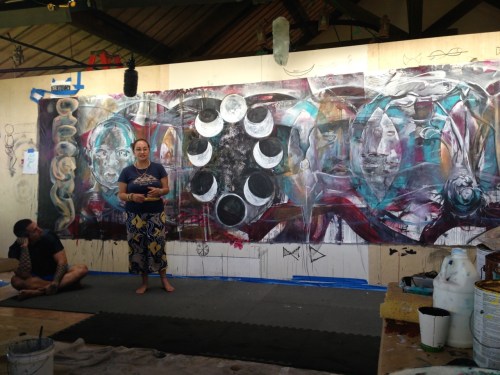
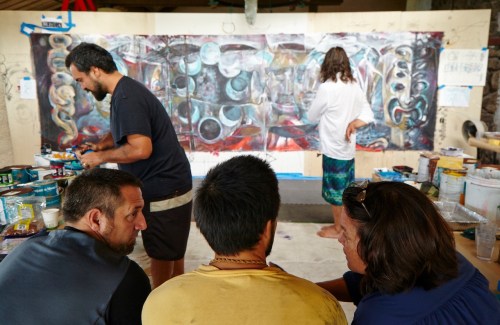
I left the Think Tech Hawaii studio and drove out to Camp Mokule’ia, where Mary and Jon Osorio and 65 other members of Calvary by the Sea Lutheran (ELCA) gathered for our annual weekend-long retreat. The same group of artists– Al Lagunero, Meleanna Meyer, Harinani Orme, Kahi Ching, Carl Pao & Solomon Enos  – who made the mural exhibited at Mark’s Garage, also painted  a couple of them on the campgrounds.  As the weekend unfolded, the presence of Meyer and her collaborators, through the murals, provided a vivid backdrop for our community strengthening programs of yoga, dance, history, art, worship, etc.  As I mentioned in the conversation with Meleanna, Where is the place for Native Hawaiians to gather and learn about our culture, history, without passing entrance exams based on foreign systems of education?  Where is our place as a community to grieve the horrific 90% depopulation of Hawaiian people through the unintended (smallpox, syphilis, measles, etc) genocide of the 19th century? Why not build a puʻuhonua  where we can bury the iwi with proper respect, teach ourselves and the children Hawaiian culture?

Like the Kuʻu ʻĀina Aloha Project, some of this is already happening, especially in the Hawaiian immersion schools, civic clubs, hālau for arts like hula, canoe clubs.  Perhaps the best example of healing through learning about culture is the work of the Polynesian Voyaging Society.  It’s not surprising one of its founders, Myron “Pinky” Thompson had a Masters in Social Work, and dedicated his life to healing what he called the Hawaiian Sickness, but today we would call generational trauma. PVS’s work is certainly not limited to the Hawaiian community, and has become a powerful model globally.

http://

The Beauty of Mauna Kea by Keola Beamer, performed by J. Osorio, B. Kau, T. Sprowls at Camp Mokulēia from Kaui Lucas on Vimeo.

Between Jon and Meleanna, a cohesive picture is emerging, which I endeavor to share. In the meantime,  take the time to participate in the life of your community, whatever it is.  And if that isnʻt your cup of tea, you can always be on the support team for projects like Kuʻu ʻĀina Aloha and PVS’s Mālama Honua Worldwide Voyage, making it possible for this critical work to be done.
AHA ALOHA AINA MURAL 198

In process, the AHA ALOHA AINA MURAL

Kalama.red

David H. Kalama, Jr. Managing Partner, Kuʻu ʻĀina Aloha
ku'u_āina_aloha_8_28-30_13_102

The artist team included, including Solomon Enos, standing left, Al Lagunero, Kahi Ching, Harinani Orme, (not in picture) Carl F.K. Pao, seated left, Meleanna Meyer seated right.
alohaainamarch

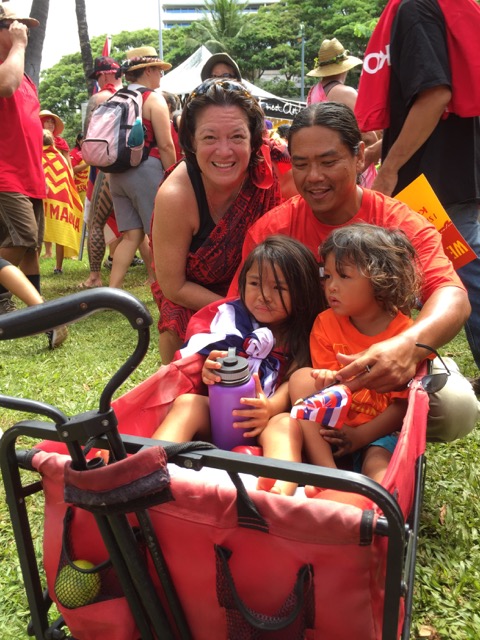
Meleanna Meyer and Joe McGinn at the Aloha ‘Āina Unity March. Some times healing means taking the issues to the streets.

sketch.globe

Sketch for the mural.

ku'u_āina_aloha_8_28-30_13_541

Refection and discussion were vital parts of the collaborative process.
IMG_4697

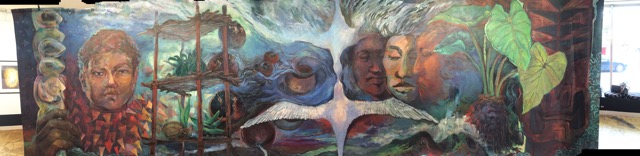
Today’s guests; Meleanna Meyer presents the newest phase of this groundbreaking healing work, an interactive installation at the Arts at Mark’s Garage.  Part of the Kuʻu ‘Āina Aloha project, a muti-modality approach to addressing the lingering impacts of cultural trauma birthed by the 1893 overthrow of the Hawaiian Kingdom.

Absent a Truth and Reconciliation process, the legacy of the overthrow continues to wreak havoc in the lives of  all who live in Hawaiʻi.  From incarceration, houselessness, chronic illness, and the usual post-colonial social ills in the Hawaiian community, to the Maunakea TMT debacle, the greater community of all who live here are in need of a healing process.  Meyer shares her journey.  Tune in at 3pm HST to Think Tech Hawaii.com

What a day Friday was, from the tribute at Magic Island for kumu hula Leinaʻala Kalama Heine, to Think Tech Hawaii’s studio for premier of Hawaiʻi Is My MainLand.  Hula sister Mary Osorio, with whom I had the honor of being haumana to Leinaʻala, is married to Jon Osorio, the beloved musician, composer, author, scholar, and professor at Kamakakūokalani Center for Hawaiian Studies, at the University of Hawaiʻi.

The theme of the day was the recent Department of the Interior announcement regarding Native Hawaiians.  Jon and I discussed the convoluted issues around nation building within and without the carefully constructed box the proposed DOI rules have made to contain the government Native Hawaiian’s choose to create, 1) if they choose to create one, and 2) if the one they create meets the standards set by DOI. If you really want to do some homework here’s a link to the document, including instructions for submitting comments. It’s only 73 pages, and the summary is only a paragraph.

The pronoun “they” is used although I am part Native Hawaiian, because I don’t have official documents that “prove” it. Jon discussed Naʻi Aupuni‘s  complicated and conflicted role.  I admit after being a conscientious roll objector for decades I had a weak moment a couple of weeks ago when all the announcements about the up coming ʻAha  elections started getting louder. I called Naʻi Aupuni. “Why doesn’t your mother’s birth certificate say Part-Hawaiian? ” the nice Naʻi Aupuni staffer asked.
“Because in 1923 no one wanted to be Hawaiian,” was my too honest answer.

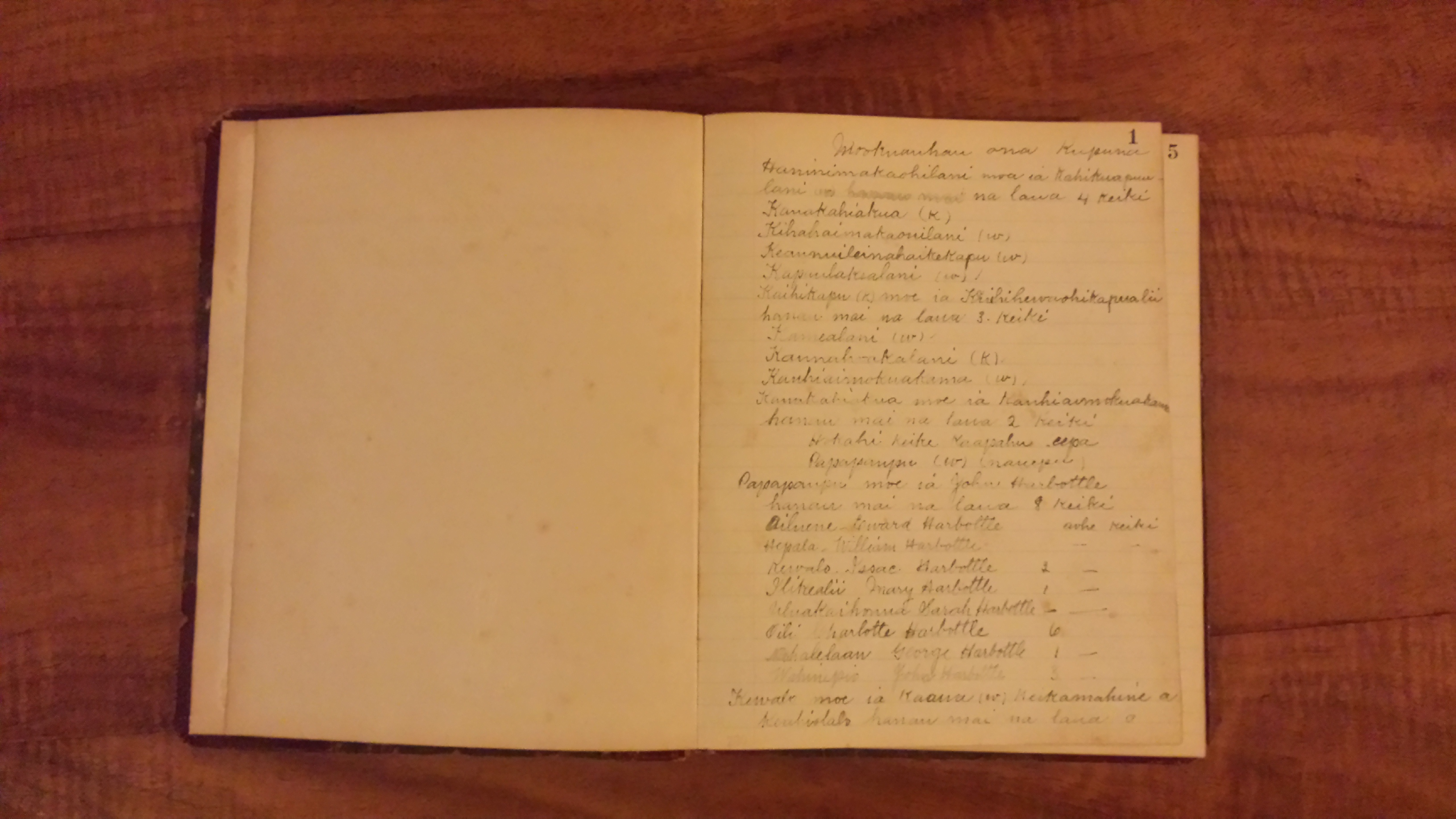
He thought I had an “unusual case,” and should try contacting OHA, which is also still enrolling Hawaiians. Last time I counted I had 50 some relatives within a 1 mile radius. We have lived, loved, and died in Hawai’i generation after generation, since before Captain Cook was a sparkle in his parent’s eyes. Tant pis that my great-grandmother’s handwritten family genealogy, in ‘Ōlelo Hawai‘i just isn’t good enough for the agents of the United States, the State of Hawaii, OHA, Kau Inoa, Kanaʻiolowalu and Naʻi Aupuni.

The biggest takeaway is that this whole DOI process is a red herring, and Jon needs to come back and continue de-mystifying the issues around Native Hawaiians and sovereignty.

Mary P.Bannister Lucasʻs Handwritten Geneaology

When Think Tech Hawaii‘s  Jay Fidell told me last Friday I could have a weekly show from 3-4 on my favorite day of the week, Fridays, I was elated, and grateful, to have a platform to actually dialogue Hawaiʻi issues I care about with knowledgeable, committed, community minded people.  No surprise to those of you who know me that I  soon called  dear friend, musician, and storyteller, Jonathan Osorio; a full professor at Kamakakūokalani Center for Hawaiian Studies,  and recipient of the 2010 Robert W. Clopton Award for Distinguished Community Service. He is also husband of Mary, who is as diversely wonderful in a galaxy of other ways, and father of 5 audaciously talented children.

Photo taken at Calvary by the Sea Lutheran church where the Osorios and I can usually be found on Sunday mornings.

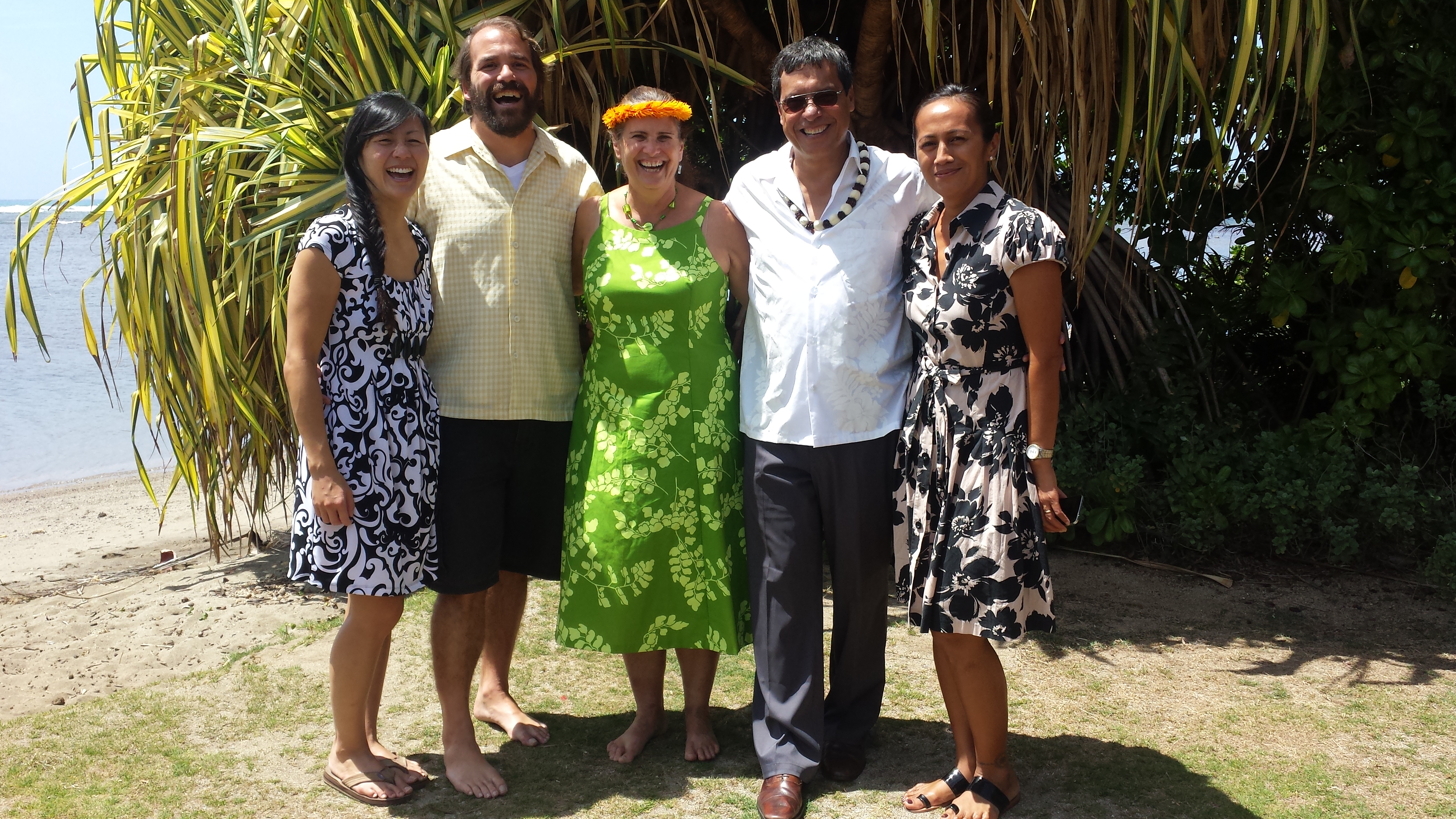
Mary (green dress) and Jon (white aloha shirt) Osorio with friends visiting for a conference on Pacific Island Women this Spring.

What was a surprise, is that a few days after agreeing to be my first guest, he would be spending a very busy media week addressing the announcement by the US Department of the Interior, “. . . proposing a administrative rule to facilitate the reestablishment [sic] of a formal government-to-government relationship with the Native Hawaiian community to more effectively implement the special political and trust relationship that Congress has established between that community and the United States.”  Livestreaming on the internet today at 3pm HST on Think Tech Hawaii‘s digital platform.  Send us your questions via Twitter to @ThinkTechHI. And please, tweet responsibly, don’t tweet and drive.

This week Jay Fidell offered a weekly show for Hawaiʻi is my Main Land on Think Tech Hawaii. Appropriately enough the show will be on Aloha Fridays at 3pm.  A perfect way to end the week and launch pau hana!

Think Tech Hawaii’s digital media platform will give me a chance to talk with other community members who care deeply about the fabric of our society and natural resources, as well as viewers via tweets to @ThinkTechHI, Mahalo Jay!

He inoa . . . who ???

Who the heck is Kaui Bryan Lucas?

Who the heck is Kaui Bryan Lucas?

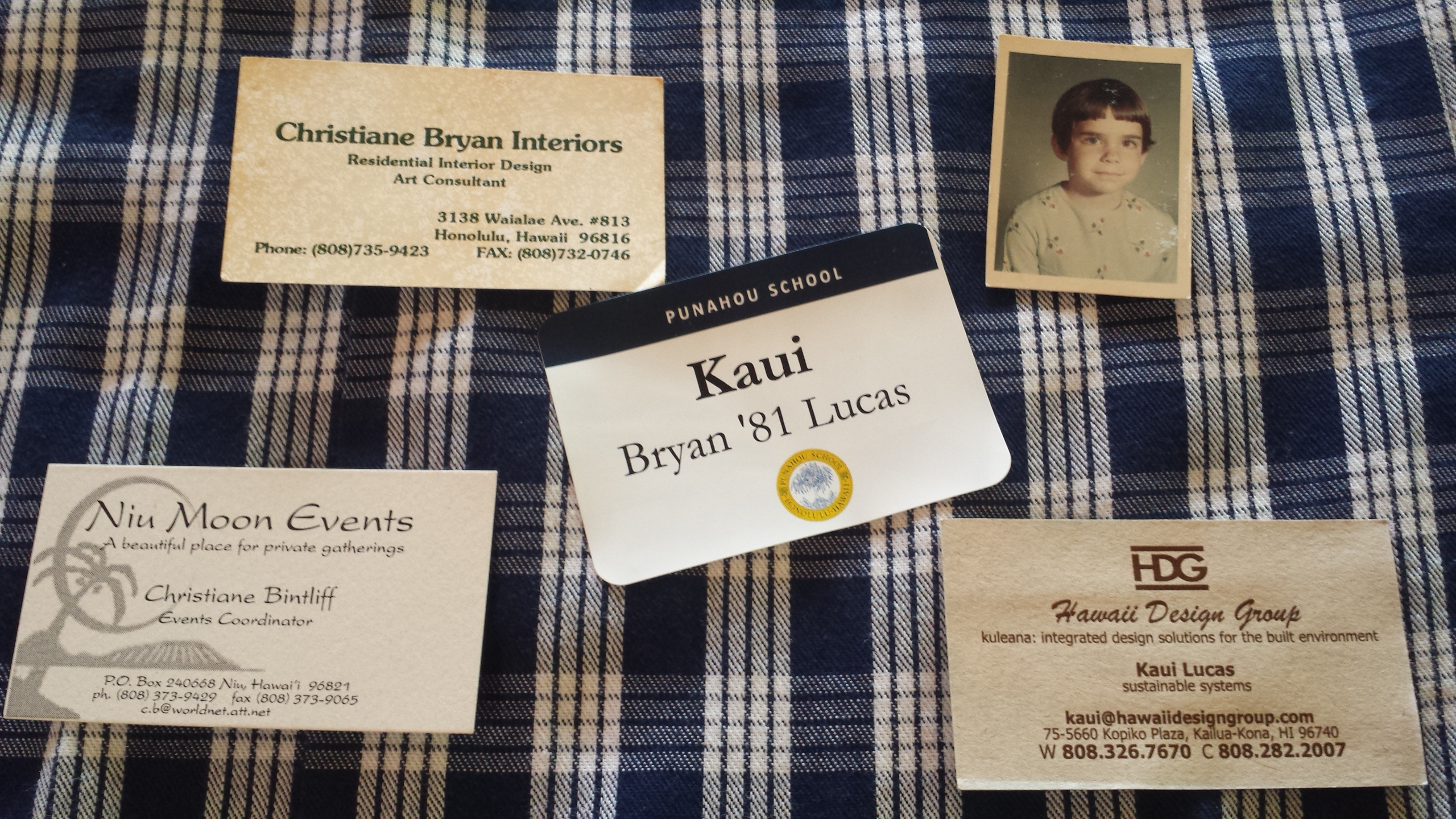
Even if more than anything save DNA, growing up in the Hawaiian archipelago has determined my path, I am puzzled when somebody asks me where I’m from, and then congratulates me, as if it were something I’d earned. I do take credit for choosing to live most of my life in Hawai’i, as well as editing that most usual of personal identifiers, my name. A couple of days ago at a high school reunion planning meeting I saw a version of my name I’d never seen before, Kaui (short for my middle name, Kaulana) Bryan (my maiden name) Lucas (my maternal grandmother’s name, which I took following a divorce in ’06 and absolutely love because it’s short and I don’t have to spell it.)

Chatting genealogy with my niece Maile not long ago, so happy that she has been actively archiving family lore, I discovered a problem.  Much to my surprise, she wasn’t sure what my birth name was. Even for family tree given to frequent pruning and grafting, apparently my periodic rebranding has had unintended consequences.

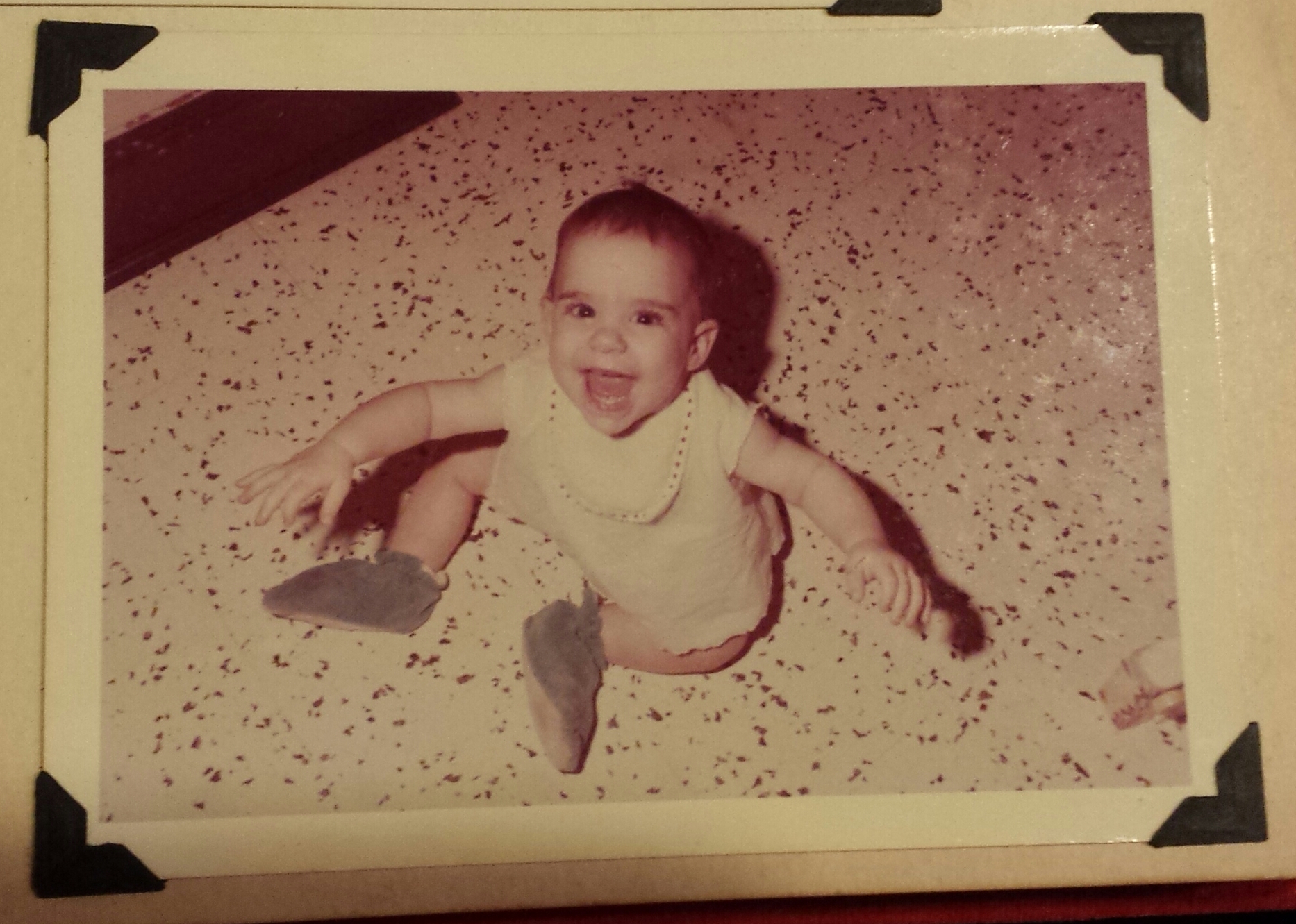
A recent birthday seemed like a good time to sit down and clear the record. Like Barry Obama (who is also using a different than the one he used at Punahou) I was born at Kapiʻolani Hospital.  For the record, my birth certificate reads: Christiane Kaulana Bryan.  I was named Christiane after my father’s godmother, whom I never learned anything about, except my mother liked her name.  My mother died when I was nine.  If there is something you’ve long wondered about in your family, but haven’t gotten around to asking. . . you have my permission to ask whomever it is, NOW.

Kaiku’ana Mary Mapuana Bryan didn’t have a choice.  She was going to be a Mary. Both our grandmothers were Marys. AND, Mapuana was born auspiciously close to our great-grandmother Mary Papapaupu (Nauepu) Bannister Lucas’s 100th birthday. “Mapuana” was chosen by our Dad because there was a beautiful Hawaiian Airlines flight attendant with that name.  Sister Mapuana had a hard time pronouncing it as a baby, and called herself Mana instead, so that’s what she was known as until she went to Punahou in the 7th grade. Our parents Shada and Ed Bryan lived on Ewa Sugar Plantation. The father of Mapuana-the-flight-attendant was a plumber who lived nearby in Hono’uli’uli. Why do I know so much about her name but next-to-nothing about mine? Oh yeah, she’s Kaikuʻana.

I’m equally clueless about my middle name, Kaulana. It is not one historically in the family. Mother’s middle name, Ilikealiʻi has been reissued a couple of times in the 5 generations since it first appeared on any record I know of. Part of it “ilikea,”  means “fair-complexioned person.” So it is not likely from further back than the two pre-1778 generations I do have of our moʻokūʻauhau.

I’d  like to think mother consulted with her grandmother, Mary Papapaupu (Nauepu) Bannister Lucas. Nana was 101 when I was born. Sometime towards the end of her life (103) she stopped speaking English and reverted back to her mother tongue, ʻŌlelo Hawaiʻi.  Childhood friends of my mother reported to me that when a baby was born in the Lucas’s circle, Nana would visit the baby, and practice appropriate protocol. 

My mother, typical for her early 1920’s generation, only knew a few flavoring particles in Hawaiian. Phrases used when you didn’t want children to understand, or euphemisms for indelicate English words. Like kūkae, or puhi’u. Fascinating that the ʻŌlelo Hawaiʻi was socially acceptable whereas the English was not. Anyway, it is not at all clear that Nana at 101 had anything to do with choosing my name.

So where did Kaui come from?  Short answer: Kaui is to Kaulana what Christi is to Christiane.  As a child I was called Christie. Seventh grade I changed it to Christi. By 9th grade I was ready for the real deal: Chris-ti-ane.  Only hardly anyone would pronounce it correctly: 3 syllables ending in”ahn.”  I ALWAYS had to spell it. . . except the three years I lived in Europe, where it is so common the tourist kiosks have Eiffel Tower keychains with “Christiane” on them .

The long answer is a complicated tragedy of deaths, divorce, unnatural catastrophic events, and lawsuits compressed into a couple of years about a decade ago. Perhaps you’ve also survived a phase of life where the biblical character Job resonates?  Or you’ve maybe had some fairly public experience drenched in catastrophe?  Hopefully you have no idea what I’m referring to.  In any event, the aftermath of that emotional carnage left me wanting to be someone else, someone other than the woman whose life was so painful most people at the mall couldn’t look her in the eye. Or if they did, she didn’t want to remember which tragedy they were probably thinking of when they recognized her.

If I had to do it over, I would still ditch Christiane (except when in Europe,) but not shorten Kaulana.  Honestly, I didn’t know another Kaui was going to publish a book about a complicated family with land on Kauai and become really famous. Oh well. @KauiLucas is great for social media.  Also,”kaui” is not a Hawaiian word. It’s doesn’t mean anything, it’s just a name. Bonus: even over the phone with my punitively enforced pidgin-free English, I don’t have to explain that Hawaiʻi Is My Main Land.20150922_234827-1

Bytes, Nibs & Scars

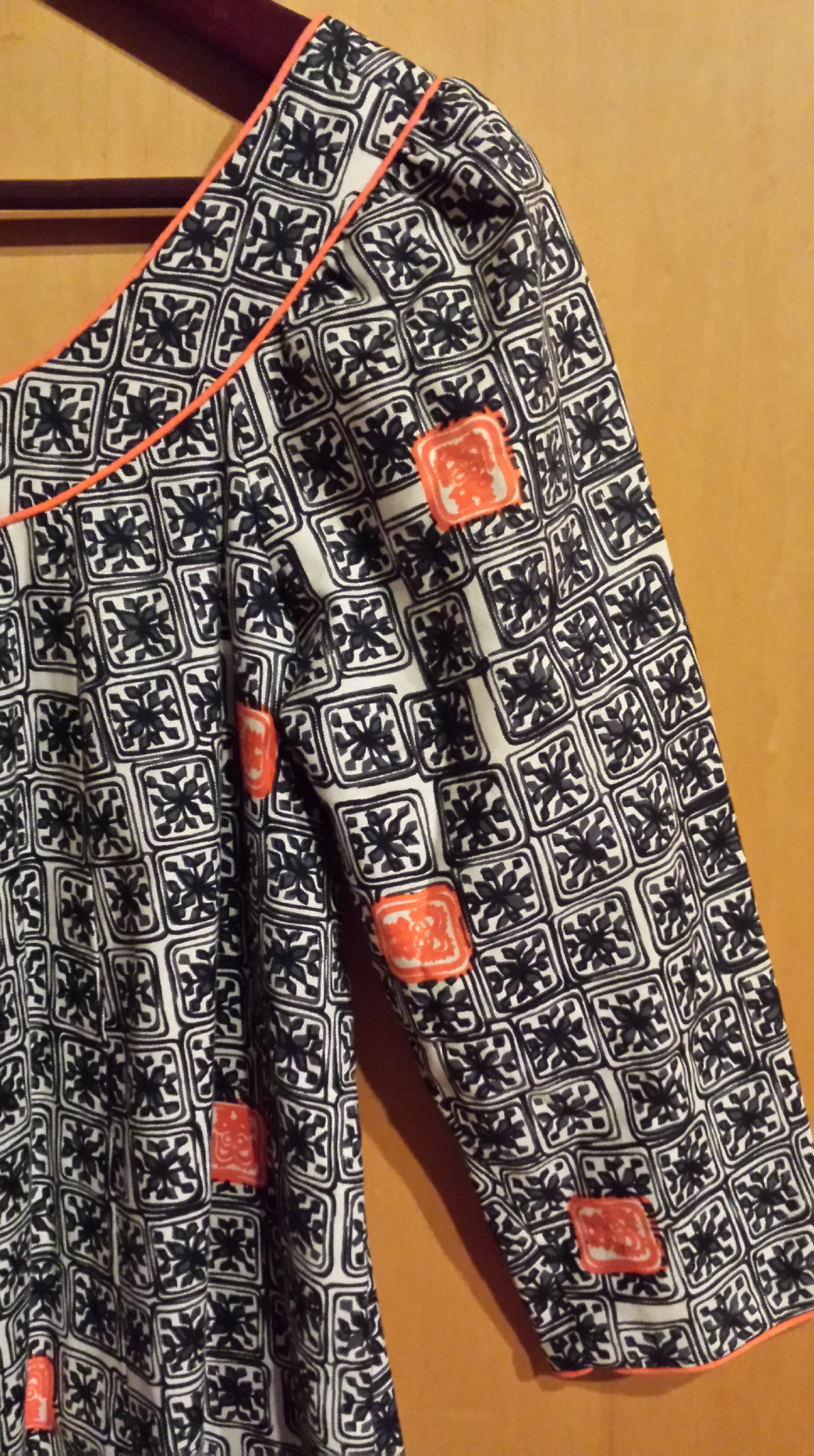
'70s muu'muu. label:  Kiyomi Hawaii / Liberty House.

’70s muu’muu. label: Kiyomi Hawaii / Liberty House.

It’s been a mere four years since I’ve published a post. This Honolulu baby is back on O’ahu with its distractions, pleasures and obligations. In the age of Snapchat, does anyone give a rat’s okolehao about blogs anymore?   I signed up for a WordPress Workshop with John LeBlanc at ProtoHub in Kaka’ako, first meeting was Wednesday night, and that is motivating me to dig out of my Facebook sandbox and engage again in Slow Post.

Last year I got my first cancer diagnosis, a melanoma.  I kinda had to wake up and admit that I was deeply unhappy with life, and if I didn’t get with the real program, I might as well fly home on the melanoma. But that’s fodder for another paddock. Much of this old blog is paleo era social media, with antiquated layout–I doubt it even works on mobile devices. It’s probably a virtual graveyard of 404 links. But instead of sanitizing, erasing and presenting the  perfect post at some mythical future date, I’m just going to publish this now, scars ‘n all.  Matches my left shoulder. NOT surprisingly, the cancer presented behind my heart.

Groovy things have been happening recently. I’ve reconnected with so many decades old friends this summer, it’s like having a life review in slow motion. More will be added tonight since it’s First Friday and rumor has it several of my Punahou classmates are in town and we are converging on my permaculture/localizing heroes Nat and Dave of Madre Chocolate in their new garden venue downtown, on Pauahi St.  My classmate Dan McLaughlin is playing folk-ish music with some pals.  Music, chocolate, whiskey, high school buddies. That’s how to prevent melanoma recurrence.

I might wear that amazing Liberty House 70’s mu’u I scooped at Saver’s Monday night. I wonder if it shows the scar?

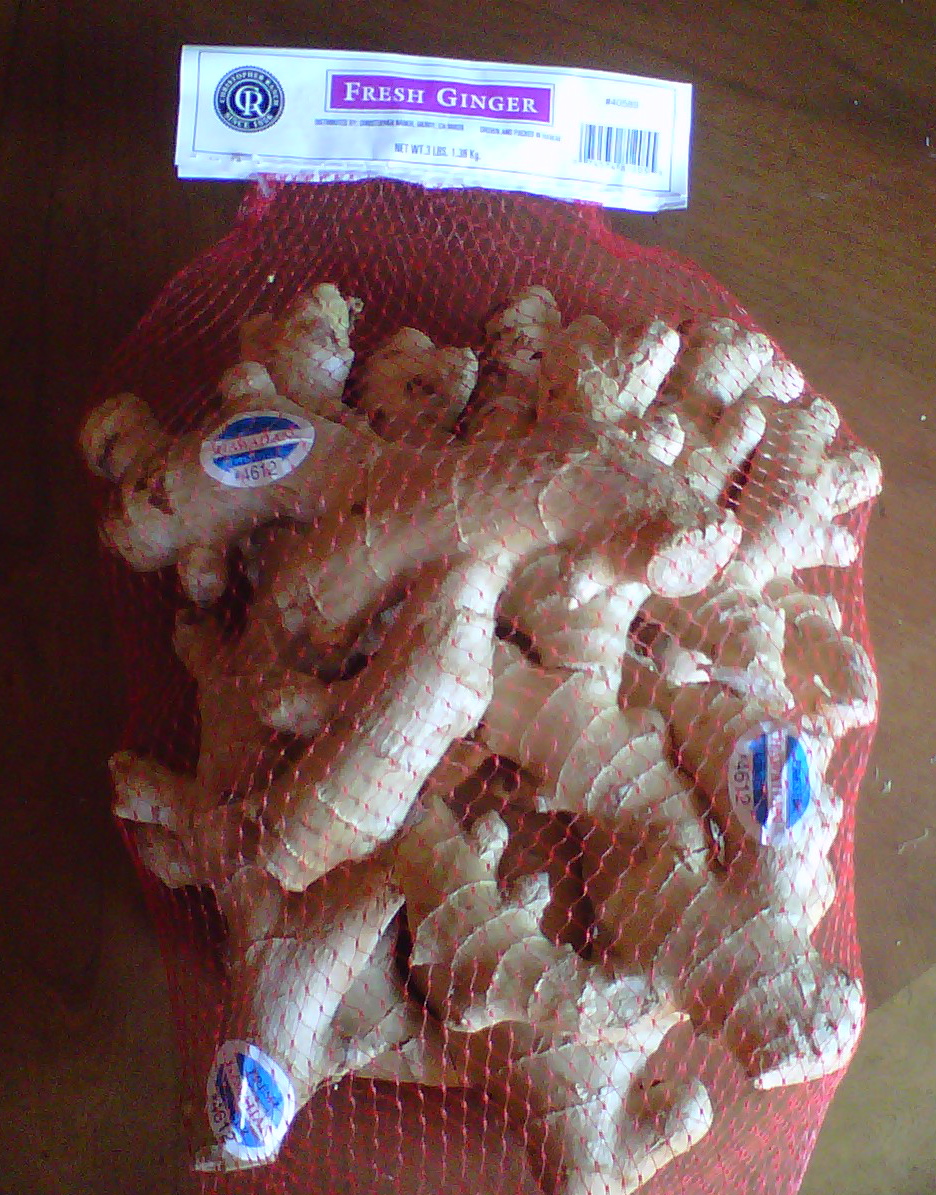
3 lb. bag of ginger sold at Costco

My love/hate relationship with Costco continues.  I am recently guilty of buying two gallons of OJ because it was less than the price of two, 1/2 gallons, at KTA.  Now I’m giving 2 of the four 1/2 gallons away so it doesn’t go bad.  The Little Green Book of Shopping by Diane Millis says something like 30% of food is wasted in the UK and US. That’s a bit excessive.

In a tweet last summer I ranted,  “Costco is selling Mexican(small logo) mangoes distr. in CA (large print) in PLASTIC & cardboard in Hawai’i- PROTEST!!” What I couldn’t include with only 140 characters, was what I said to the unfortunate frazzled Mom  standing next to me who wanted to buy them. “Are you really going to buy mangoes from Mexico during mango season in Hawai’i?”  I asked incredulously.  She didn’t appear to be a wholesaler, judging from the contents of her cart.  She said something about their tree didn’t have any, which is plausible. We only got a couple dozen up in Holualoa, it’s been so dry.  Still, it seems a weak reason to buy produce from 2500 miles away when better quality of the same item is available down the street.  But who has time to go down the street when you are looking for healthy snacks for a Cub Scout meeting, as this innocent consumer was?

The packaging was just so over-the-top, it triggered  my Joan of Locavore ire.  First, the misleading labeling, graphically designed to disguise the foreign origin of the mangoes.  Then, the plastic space bubbles–individual depressions in the plastic for each mango, and surrounding that a cardboard retro-flat crate.  It’s cheap enough with all that packaging expense that they are bought “wholesale” at Costco and resold at the Kona Farmer’s Market on Ali’i Drive to unsuspecting shoppers assuming they are local.  Yes, I fact checked.  This is so wrong on so many levels.

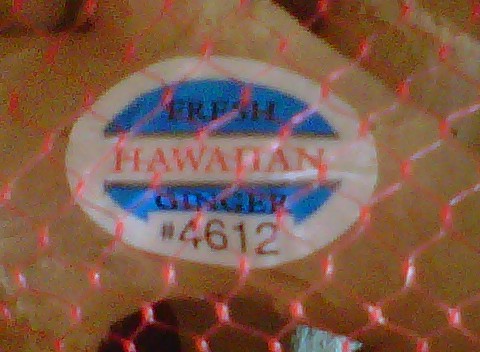
All that is to say I have some negative feelings about Costco.  The positives are obvious; price, return policy, and they do sell locally sourced goods, including local  produce (even organic).  That’s how I found out the good news about the ginger.

A previous blog mentions Ken Love‘s story about ginger.  He wrote an excellent article about the real problems with mislabeled produce: http://blogs.hawaiibusiness.com/2010/10/08/hawaiian-ginger-product-of-china/.  Ginger is one of the scary stories with roots from China, North America, and Hawai’i in the same bin at the grocery store.  I had to put on my glasses to find out the Costco ginger was local.

DISTRIBUTED BY: CHRISTOPHER RANCH, GILROY CA 95020 GROWN AND PACKED IN HAWAII

It looked local, but the display didn’t mention local produce or Hawai’i grown.  The brand, Christoper Ranch from California, is famous for their garlic.

So good things are happening, even if it’s not obvious.  Ginger growers in Hawai’i have found a way to sell their produce to a larger market.  Hawaiian ginger is making a name for itself in the world.

The most useful blog in my world is Hawaii Agriculture. They keep current, and really cover the field (and sometimes stray into the ocean and forest.)  A recent post alerted me to potential perils in the produce section: http://hawaii-agriculture.com/hawaii-agriculture-blog/west-hawaii-today-features-food-sustainability-a-kona-vores-dilemma, right here in Kona.  The issue is produce that isn’t local, being sold as such,  sometimes mixed into the same bin with local produce.  Talk about a hot topic for local farmers!

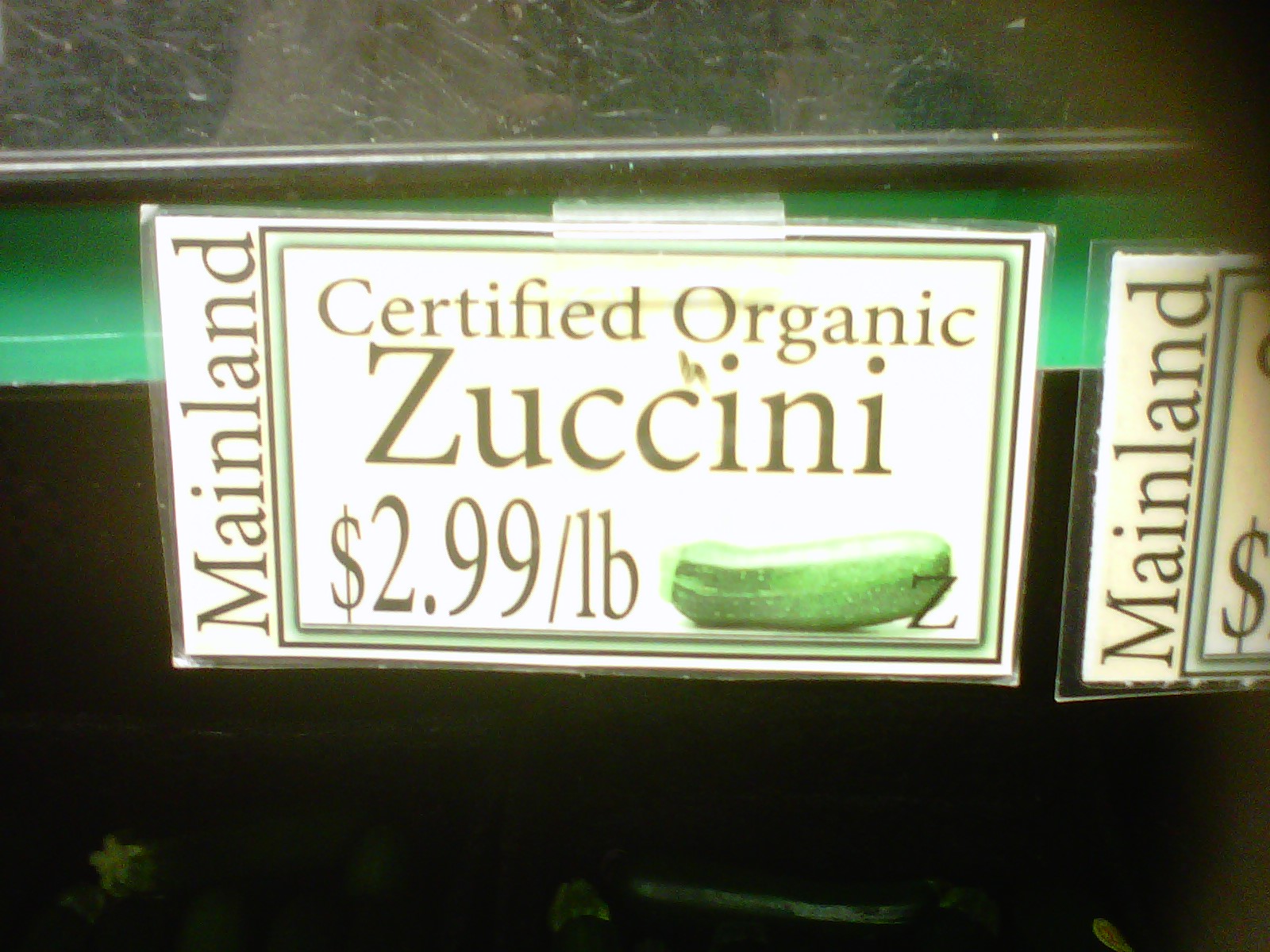
But I was just thinking about what to cook for dinner while shopping the next day at my favorite local natural food store, Island Naturals Market & Deli.  I like them so much I kind of felt bad about writing  this post, but hey, as ye show, so shall ye reap.   I found some gorgeous organic courgettes.  No price, no problem, friendly Produce Man is 6 feet away.  He dug around and put up the tag.   The price for not going to the Farmer’s market, $2.99 a lb, but they are deep green, and gorgeous, and . . . they’re from MEXICO???

Trying to stay off my soap-box, I  said to Produce Man as innocently as I could, “the tag says ‘Mainland,’ but the labels say they’re from Mexico (organic at least).”   He stuttered a bit and said something about only having “local” and “mainland” tags, and admitted there was a problem with about four of their products.  I couldn’t help saying, “Hawaii’ is my mainland, by the way, but the point is Mexico is a foreign country with different standards for organic.”

“I’m from Sweden,”  he smiled, ”  I see your point, and I hope by the next time you come in we’ll have that fixed.”  He could have argued that there are more Kona area residents native to Mexico, than are native to any other of the “States” not on the West Coast.  Like I said,  Produce Man is a nice guy. Now that I’ve done some research, it looks like Mexico’s standards are ok.  STILL!   I had to go back the next day as it turns out, and the signs remained the same– but that’s not much of a grace period for corporate policy changes.

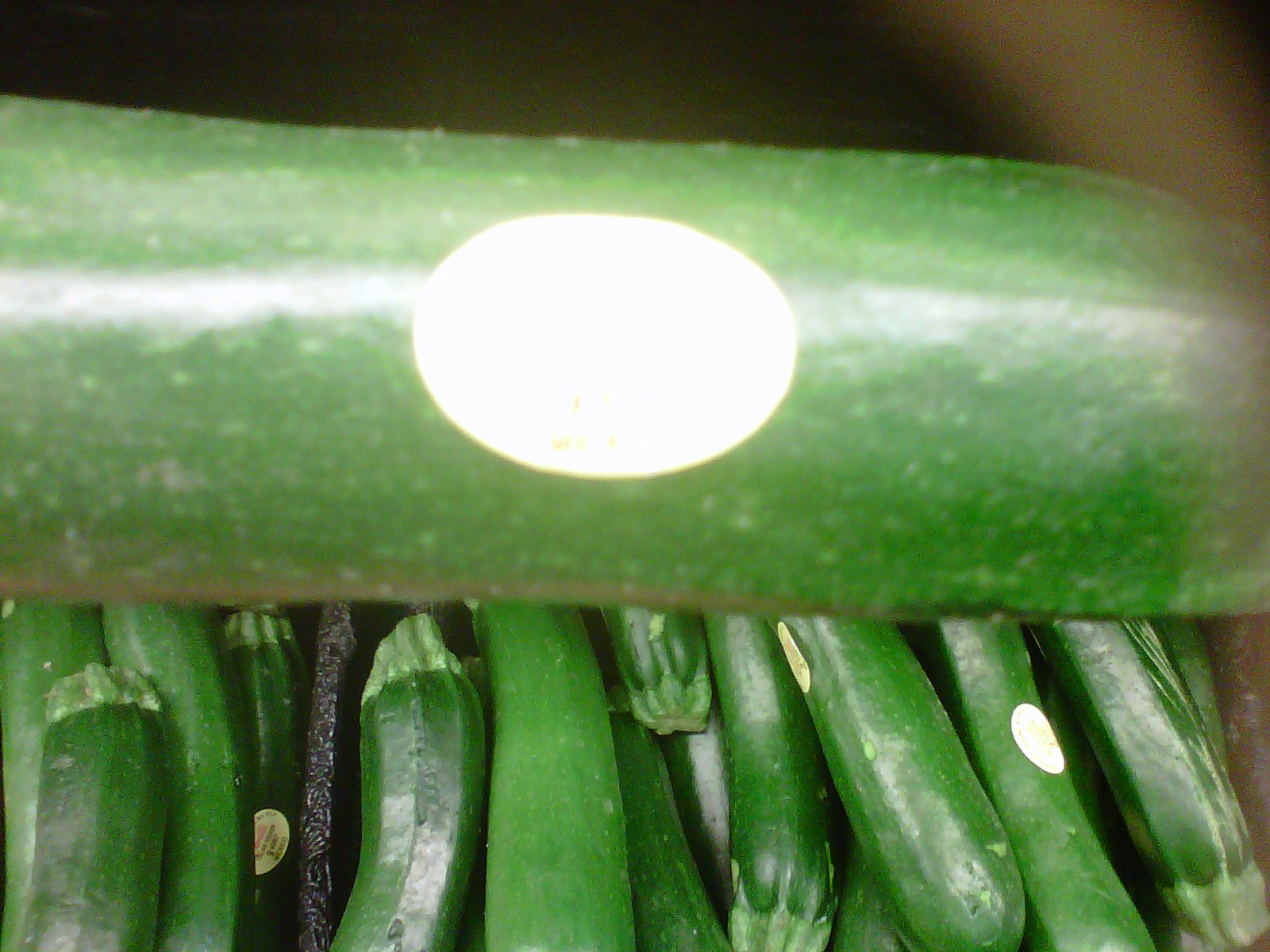
A few days later I’m at my favorite conventional supermarket, KTA.  The same cute Mexican courgettes with the yellow label (my phone camera doesn’t have a flash) are in the organic produce section.

the pretty courgettes from Mexico

The nearest origin tags say “product of USA.”   KTA has tracks on the shelf edges to put the tags on, and they don’t specifically reference the item they refer to.   So, I just turned the “product of USA”  label over.

Back to the Hawaii Agriculture blog.  What about local-not-necessarily-organic  vs organic imports? The BBC writes in a great little article, “Local food is usually more “green” than organic food, according to a report published in the journal Food Policy.”

PS-

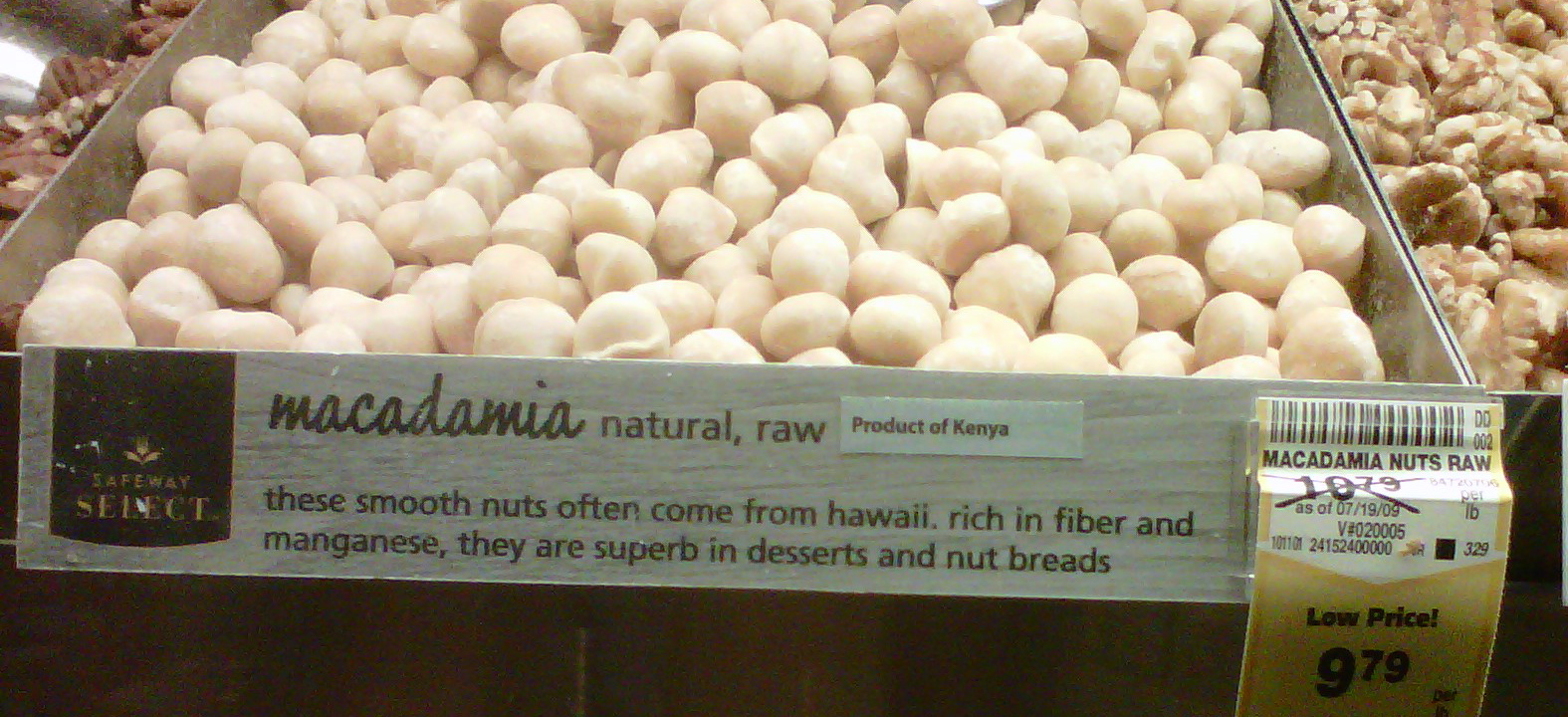
Safeway’s label takes the cake for localwannabe:

product of Kenya

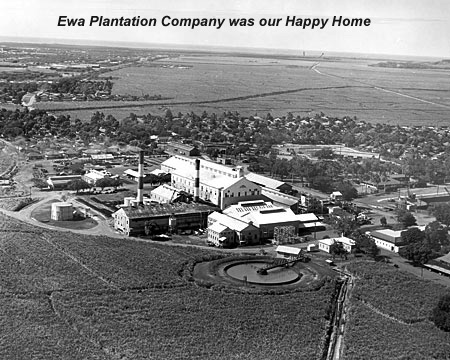
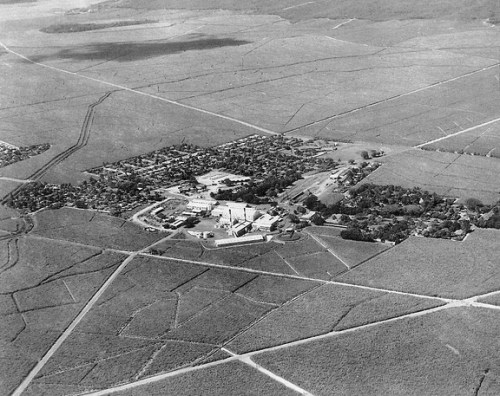
‘Ewa Sugar Plantation (ca 1890-1970) as mentioned in a previous blog,  was my childhood home.  One day a friend and I were heading out to that side.  It is painful to see what that simple, charming community has degenerated into, I don’t go often.

First thing, since we were coming from Kapolei side, I got lost.  A testament to the City and County’s aggressive development of the ‘Ewa plain agriculture lands. We approached from the old Barber’s Point (Kalaeloa) gate along the old Oahu Land & Railway tracks, past the Hawaiian Railway Society. (Extra)

Varona is the first of the ‘Ewa Villages.  Seriously dilapidated, both physically and by scandal, but still inhabited. One of the things Varona was famous for is cockfighting.  Although, the only one I ever saw was in Fernandez Village.

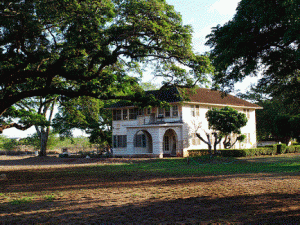
We drove past the mill that isn’t there anymore.  Past the park with magnificent old royal palms, the only way to identify the town from the surrounding area.  Then into the driveway, which used to be lined with royal palms as well. My friend Joe grew up in Waimanalo, but like most people, including locals, had never been to Ewa Plantation, and was shocked at the extent of  deterioration.   The once spectacular landscaping reduced to dead grass and dirt.  A few of the old trees have survived.

We followed the driveway around the house, now occupied by a church and community association.  No one was there.  Outside the courtyard with dry fishpond, was a splendid pile of the old shutters!  They were there a couple of years ago on my last visit.  A combination of nostalgia and my commitment to sustainability kicked in.  Several of the wood louvers were no longer attached to the frames.  Frames. The wood remained miraculously unmolested by bugs.  Probably because of the lead based paint. The forest green slats were attractively time worn, fabulously faded by natural processes.   Picture frames. (!)

My wonderful brother-in-law, Dennis, who lives in Wisconsin, was a picture framer in his early days.  He’s moved on to more exotic projects, like weaving shuttles and looms, but he might be convinced to make some for his wife and her siblings.   Would that be stealing? Is it a crime to steal discarded items for non-commercial reuse?

I remember picking some thimble berries from our neighbor’s hedge once. My Mother insisted I go knock on their door, apologize, and ask for permission.  I did, wracked with shame, sniffling out my repentance.  The guilt induced was far more effective than the alternative of spanking. Fortunately Mrs. Cushnie was gracious, and invited me to take as many as I wished, anytime.  Lingering guilt prevented any future gathering forays.  Strange how 40 years later I my opu still contracts.  There was no one to ask for permission. Would anyone notice?  Ok, that’s hardly an acceptable moral standard.


As far as I’m concerned, there are no publicly accessible structures of historical charm between Waipahu and Ka’ena Point, you have to go to Wahiawa or Haleiwa.  Some of us appreciate the kuleana of Honouli’uli, but it’s no place for sightseeing.  The years of  labor and resources my parents invested in creating and maintaining this little plantation jewel were utterly destroyed.

Would Messrs. Jacques Pryor and William Messer,  high school European Studies teachers at Punahou, find my sentimental/environmental  arguments valid conclusions of moral discourse?   We put the wood pieces in the trunk and continued through town.

Isamu Murakami, who also grew up on ‘Ewa Plantation, has posted over 600 historical images on his Picasa site: http://picasaweb.google.com/waipahu46/MYHOMETOWNEWA#